

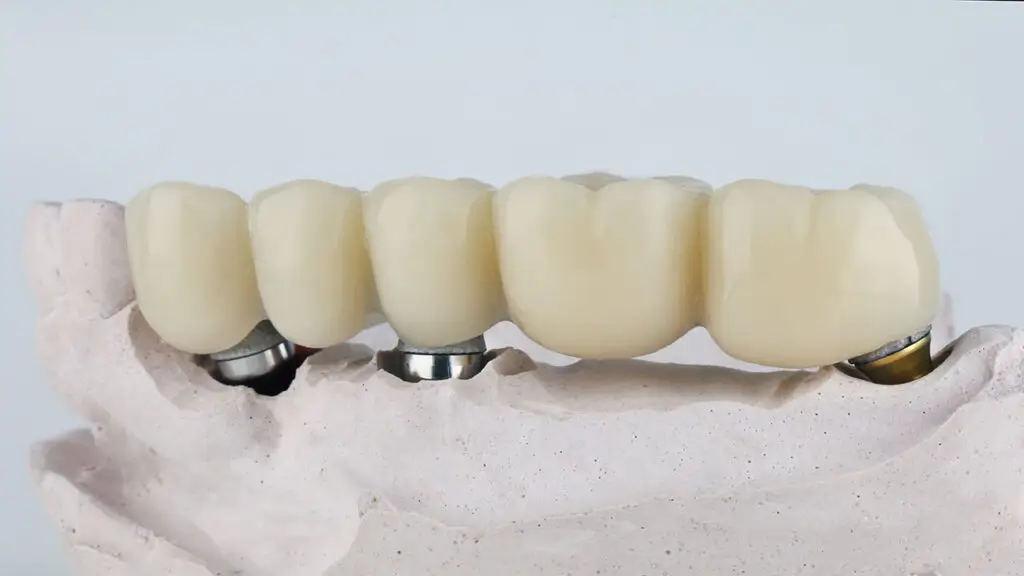
Losing several neighboring teeth creates a unique challenge. The goal is not only to place replacement teeth into an open space. The new teeth also need to work together, support balanced chewing, protect the remaining smile, and feel secure during everyday use. For patients missing multiple teeth in a row, implant bridges can provide a coordinated fixed solution without requiring an individual implant beneath every replacement tooth.
Implant bridges use dental implants as anchors for a connected group of replacement teeth. This makes it possible to restore a larger gap with a smaller number of strategically placed implants. Because the bridge is fixed to those implants, patients do not remove it at night or depend on clasps to hold it in position.
How Implant Bridges Work
To understand implant bridges, it helps to picture a traditional bridge. A conventional dental bridge usually uses natural teeth on each side of a gap as anchors. Those teeth are prepared for crowns, and the replacement teeth are connected between them.
An implant bridge changes where the support comes from. Dental implants are placed in the missing-tooth area and serve as the anchors. The bridge is then attached to the implants rather than natural teeth.
This approach can be especially useful when several teeth are missing together and the neighboring natural teeth are otherwise healthy. Instead of changing healthy teeth to support the bridge, implant support can be created within the missing-tooth area itself.
Does Every Missing Tooth Need Its Own Implant?
Not necessarily. One important feature of implant bridges is that several replacement teeth may be supported by fewer implants.
For example, a section involving three missing teeth may sometimes be restored with a bridge supported by implants positioned at either end. Longer spans or areas exposed to greater bite forces may require different planning.
There is no universal formula because the number of implants depends on bone support, the location of the missing teeth, bite forces, the length of the bridge, and other individual factors.
The purpose is not to use the fewest implants possible. The purpose is to use the right amount of support for a restoration designed to function reliably.
Why Several Missing Teeth Can Create a Chain Reaction
A row of missing teeth affects the way the mouth distributes chewing pressure. Patients may begin relying heavily on the opposite side, which can change normal eating patterns.
Teeth surrounding the gap may also begin to move. A neighboring tooth can tilt toward the open space, while a tooth in the opposite arch may shift because it no longer contacts another tooth when biting.
These changes do not always happen immediately, but leaving several teeth missing can alter the balance of the bite over time. Restoring the area with implant bridges can help rebuild support where it has been lost.
Planning the Implant Positions Around the Final Bridge
Successful implant treatment starts with an important question, where do the final replacement teeth need to be? The implants and bridge should be planned together rather than treated as two unrelated stages.
Imaging can help evaluate the available jawbone and determine potential implant positions. At the same time, the planned tooth size, shape, bite, and spacing need to be considered.
The final goal is a bridge that looks natural and distributes chewing forces appropriately. Thoughtful planning can also make home cleaning more practical, which matters for the long-term health of the implants.
What Happens During Treatment?
The treatment sequence for implant bridges usually begins with evaluation and planning. If damaged teeth need to be removed or the implant sites require preparation, those steps are incorporated into the plan.
The implants are then placed and given time to heal. Temporary tooth replacement may be available depending on the location and circumstances.
Once the implants are ready to support the restoration, the final bridge is designed. The bridge needs to coordinate with neighboring teeth in shade and shape while also fitting the bite comfortably.
After placement, the bridge is checked carefully to make sure chewing pressure is balanced and that patients understand how to clean around and beneath it.
Benefits of Implant Bridges
- A fixed solution for multiple missing teeth: Implant bridges can restore several neighboring teeth with one coordinated restoration.
- Fewer implants than one-per-tooth replacement: Depending on the treatment plan, several bridge teeth can often share implant support.
- Protection of healthy neighboring teeth: Implant-supported bridges usually do not require adjacent healthy teeth to be prepared simply to anchor the restoration.
- Improved chewing support: Restoring a larger gap can help patients distribute chewing pressure more evenly.
- Stable daily function: The bridge is attached to implants rather than being removed by the patient.
- Customized appearance: The replacement teeth can be designed to blend with the proportions and shade of the surrounding smile.
- Jawbone support around implant locations: Implants transfer functional pressure into the jaw where they are positioned.
- No removable clasps: Patients who prefer a fixed restoration do not need visible or hidden clasps to retain the bridge.
Implant Bridges Compared with Individual Dental Implants
If several teeth are missing, patients sometimes assume that every missing tooth must receive its own implant. Individual implants can certainly be appropriate in some situations, but implant bridges may allow a more efficient design.
The decision depends on the size of the gap, available bone, bite forces, and how the final teeth need to be positioned. Sometimes placing an implant for every tooth would add complexity without providing a meaningful benefit.
At other times, additional implant support may be useful. This is why the design should be individualized rather than based only on the number of missing teeth.
Implant Bridges Compared with Removable Partial Dentures
A removable partial denture can replace multiple missing teeth and remains an important option for many patients. It can also replace teeth in different areas of the same arch with one appliance.
Implant bridges offer a different experience. They remain fixed in the mouth and receive their primary support from implants. There is no need to remove the bridge each night, and patients do not rely on removable clasps to hold the replacement teeth in place.
Some patients prioritize the lower cost or removability of a partial denture. Others strongly prefer a fixed restoration. Both options can be valuable, and the better choice depends on individual circumstances.
Eating After Implant Bridge Treatment
After implant placement, the treatment area needs time to heal. Softer food choices can help protect the implants during early recovery. Patients should follow the specific recommendations provided for their case rather than testing the area with hard foods too soon.
Once healing is complete and the final implant bridges are ready for normal function, the restored area can contribute much more effectively to chewing.
This can be especially meaningful for someone who has spent months or years chewing mostly on one side. Restoring the missing section can help meals feel more balanced and comfortable again.
Cleaning Under an Implant Bridge
One difference between a natural tooth and an implant bridge is that connected replacement teeth create areas that require special cleaning. Brushing the visible surfaces is not enough.
Patients may need floss designed to pass beneath the bridge, floss threaders, interdental brushes, or a water flosser. The best tools depend on the restoration.
Keeping the tissue around the implants clean helps support long-term health. A good implant bridge should therefore be designed not only for appearance and strength, but also with practical hygiene in mind.
How Long Can an Implant Bridge Last?
There is no single lifespan that can be promised for every restoration. Long-term performance depends on several factors, including oral hygiene, bite forces, overall health, implant condition, and regular maintenance.
The bridge itself may experience normal wear over time, just as crowns and natural teeth do. Patients who grind or clench may place greater forces on dental restorations and may need additional protection.
Regular professional care allows the dental team to monitor the implant areas and address small issues early. Consistent maintenance is an important part of protecting implant bridges.
What If Bone Has Shrunk in the Missing-Tooth Area?
When teeth have been missing for a long time, the underlying ridge can change shape. This may affect where implants can be positioned.
However, reduced bone does not automatically mean implant treatment is unavailable. Imaging and a detailed evaluation are needed to understand the area. Some patients may be candidates as they are, while others may benefit from additional preparation.
Patients should not assume that a gap has been present for too long to discuss implant bridges. An individual assessment can provide a much more useful answer.
Restoring a Missing Section as One Functional Unit
When multiple neighboring teeth are gone, treating the space as one coordinated area can make a great deal of sense. Implant bridges can restore that section with a fixed solution that supports chewing, protects healthy neighboring teeth, and avoids the need for a removable appliance.
Good planning remains essential. Implant position, bridge design, bite balance, cleaning access, and appearance all need to work together. When those elements are carefully considered, an implant bridge can become a natural part of everyday eating, speaking, and smiling.
To learn whether implant bridges could provide the right solution for several missing teeth, contact The Dental Boutique at 727-999-6063 or visit 5138 Deer Park Dr Ste 102, New Port Richey, FL 34653 to Book an Appointment with Dr. Vallo.